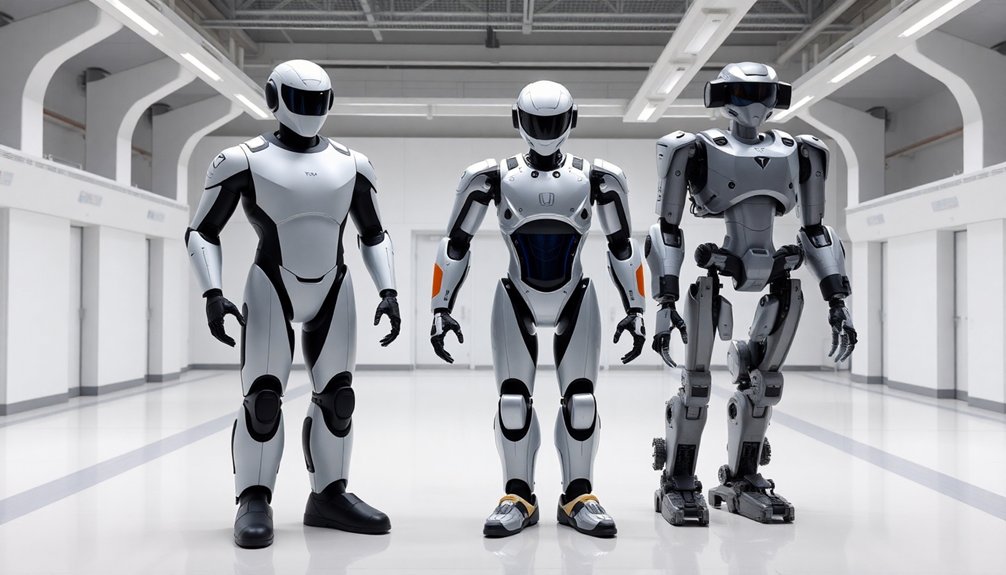
We’re witnessing an epic robot showdown between Tesla’s Optimus, Honda’s ASIMO, and Boston Dynamics’ Atlas. Each bot brings its A-game: Optimus wants to revolutionize factories, ASIMO aims to charm humans, and Atlas plans to conquer crazy terrains. They’re not just machines—they’re glimpses of our sci-fi future. Who’ll win? Different strengths, different missions. One thing’s certain: these mechanical marvels are about to transform how we work, play, and imagine what’s possible. Intrigued? Stick around.
Physical Dimensions and Design Specifications
While robots might sound like sci-fi fantasy, the physical design of humanoid machines is getting seriously impressive.
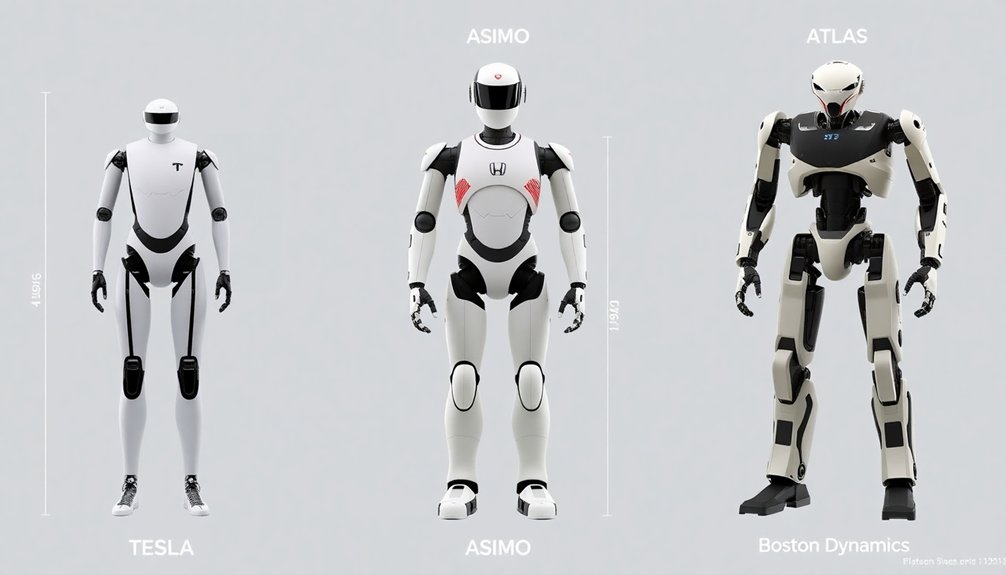
These mechanical marvels come in surprisingly different sizes and shapes, ranging from ASIMO’s compact 130 cm frame to Atlas’s towering 188 cm height.
Design aesthetics aren’t just about looking cool—they’re about functionality. Material choices play a huge role: Tesla’s Optimus leverages lightweight materials, ASIMO rocks aluminum and fiberglass, and Atlas goes hardcore with titanium and aluminum construction.
Unitree G1
A premium humanoid robot for serious demos, events, education, and advanced interaction. Best when you want a stronger,…
Robot design isn’t just style—it’s strategic science, with materials crafted for maximum performance and purpose.
Each robot’s physical form reflects its mission: Optimus aims to assist, ASIMO explores research possibilities, and Atlas prepares for rugged search and rescue challenges. Tesla’s Optimus specifically showcases advanced AI integration with its innovative design approach.
Tesla’s Optimus stands at a precise 173 cm height recommended by its engineering team for optimal human interaction and versatility.
Who would’ve thought robots could be so… diverse? From sleek and nimble to sturdy and robust, these mechanical humans are redefining what’s possible in robotics.
Technological Architecture and Artificial Intelligence
Optimus leverages Tesla’s Autopilot algorithms for robotic efficiency, while ASIMO masters human interaction through advanced recognition systems. Atlas? It’s the terrain-conquering maverick, optimizing computational challenges with hydraulic precision. Neuromorphic computing architectures enable these robots to develop increasingly sophisticated learning capabilities beyond traditional programming paradigms.
Unitree Go2
Meet the Unitree Go2 — a robot dog that walks, runs, jumps, and dances. It maps its environment…
Their sensory feedback and AI integration represent different learning paradigms. Optimus and ASIMO adapt through neural network training, fundamentally learning like hyper-intelligent toddlers.
Atlas focuses on system responsiveness in wild environments. These robots aren’t just machines—they’re computational athletes competing in the operational scalability Olympics, pushing autonomy levels we once thought impossible. The RPU’s hardware acceleration represents a significant breakthrough in robotic computational capabilities, enabling more sophisticated and efficient AI processing across robotic platforms.
Movement Capabilities and Degrees of Freedom
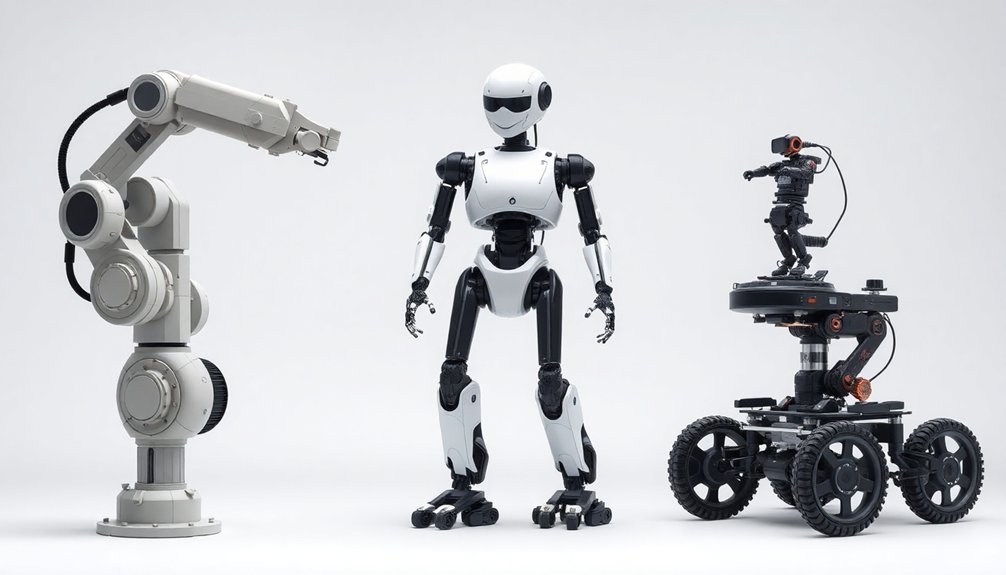
Because robots aren’t just fancy metal mannequins, their movement capabilities reveal the true magic of engineering innovation. We’re talking serious robot agility that’s pushing the boundaries of human dexterity. Advanced robotic hands are revolutionizing how machines interact with complex environments. Tesla’s recent developments in exoskeleton design highlight the integration of external actuators and advanced joint mechanisms for unprecedented robotic mobility. Educational robotics market is driving innovation in robotic movement and interaction capabilities. Check out how these mechanical marvels stack up:
| Robot | Total DoF | Hand Complexity | Mobility Highlight |
|---|---|---|---|
| Optimus | 40 | 22 DoF (soon) | Factory navigation |
| ASIMO | 57 | 13 DoF | Stair climbing |
| Atlas | 28 | Up to 28 total | Parkour master |
Each robot brings unique movement precision to the table. Optimus is catching up to human hand manipulation with its upcoming 22 DoF hands. ASIMO shows off dynamic locomotion, while Atlas redefines bipedal stability with jaw-dropping athletic moves. Who knew robots could be this nimble? The future of mobility isn’t just walking—it’s about how precisely these machines can move, adapt, and interact with their environment.
Sensors and Navigation Systems
We’re about to explore how these robots see and navigate the world – and trust me, it’s way more fascinating than your average GPS system.
When it comes to sensors and navigation, each robot brings its own quirky superpowers: Tesla’s Optimus uses camera clusters that make your smartphone’s camera look like a toy, Boston Dynamics’ Atlas can practically dance through obstacle courses, and Honda’s ASIMO moves with the precision of a robotic ballet dancer.
What’s really mind-blowing is how these mechanical marvels transform raw sensor data into split-second decisions that could make the difference between smoothly executing a task and face-planting into a wall. For instance, the 4NE-1 robot’s 3D vision capabilities enable it to recognize objects, environments, and gestures with unprecedented precision and adaptability. Tesla’s Optimus specifically incorporates autopilot cameras strategically positioned to provide comprehensive environmental awareness and real-time navigation processing. The integration of SLAM technologies allows these robots to dynamically map and understand their environment, continuously updating their spatial awareness with remarkable accuracy.
Sensor Technologies Compared
When it comes to sensor technologies, the robotics landscape looks like a high-stakes game of technological chess—and Tesla’s Optimus is making some bold moves.
The sensor advancements across these robotic platforms reveal a fascinating evolution of machine perception and sensor integration. Multi-sensor fusion technologies enable these robots to process complex environmental data with unprecedented accuracy and responsiveness.
- Optimus leverages camera systems similar to Tesla’s Autopilot for unprecedented spatial awareness
- Atlas brings lidar technology for precise environmental mapping
- ASIMO demonstrates foundational sensor capabilities with basic environmental detection
- Each robot represents a different approach to understanding physical space
- Advanced neural networks transform raw sensor data into intelligent responses
While Atlas and Optimus push boundaries with complex sensor suites, ASIMO feels like a nostalgic reminder of how far robotics has progressed.
We’re watching a technological arms race where sensors aren’t just tools—they’re the eyes and nervous system of future machines. Electromechanical actuators provide Optimus with a sophisticated sensory feedback mechanism that enables real-time environmental adaptation and responsive movement.
Navigation Accuracy Analysis
In a world where robots are inching closer to becoming our silicon-powered sidekicks, navigation accuracy isn’t just a technical challenge—it’s the difference between a helpful assistant and a trainwreck waiting to happen.
We’re diving into how these robotic contenders handle navigation adaptability. Tesla Optimus leads with AI-powered scene understanding, while Boston Dynamics Atlas crushes terrain challenges like an off-road beast. Sensor fusion technologies enable these robots to process complex environmental data with unprecedented precision.
Honda ASIMO plays it safe with pre-programmed paths, perfect for predictable indoor environments. Their sensor feedback systems are like robot spidey-senses, constantly scanning and adjusting movements.
Each has its strengths: Optimus adapts everywhere, Atlas handles rough terrains, and ASIMO nails precision in controlled spaces. The Optimus Gen 2’s advanced tactile sensors provide an unprecedented level of environmental perception and precision.
Which robot would you trust to navigate your living room without turning it into a demolition zone?
Environmental Perception Systems
Robots aren’t just walking circuit boards anymore—they’re becoming sensing machines that can interpret environments like digital detectives. When it comes to environmental perception, these mechanical marvels are pushing boundaries with their jaw-dropping sensor systems.
- Tactile feedback transforms robots from clunky machines to intuitive explorers
- Visual recognition enables split-second environmental analysis
- Multiple sensor types combine for near-human perception
- Real-time data processing creates adaptive navigation intelligence
- Advanced computing translates raw sensor input into meaningful action
Each robot brings unique strengths: Optimus leverages automotive-grade computing, Atlas dominates dynamic terrain adaptation, and ASIMO offers reliable, controlled-environment navigation.
We’re witnessing a revolution where machines don’t just move through space—they understand it, predict it, and interact with it like sentient explorers charting unknown territories.
Task Performance and Industrial Applications
As industrial automation evolves, humanoid robots are rapidly transforming how we approach complex manufacturing and logistics challenges.
We’re seeing unprecedented task adaptability with these mechanical marvels, each bringing unique strengths to operational efficiency.
Tesla’s Optimus dominates manufacturing floors, seamlessly handling precision assembly tasks while reducing human error. Boston Dynamics’ Atlas proves itself a wilderness warrior, conquering rescue missions that would make most humans quiver.
Humanoid robots: industrial precision meets daring exploration, transforming how we solve complex technological challenges.
Honda’s ASIMO, though less industrial, demonstrates remarkable human-like movement technologies.
What’s fascinating isn’t just their current capabilities, but the potential they represent: robots that can think, adapt, and work alongside humans without breaking a metaphorical sweat.
They’re not replacing us—they’re becoming our most reliable, tireless collaborators in pushing technological boundaries.
Human Interaction and Safety Protocols
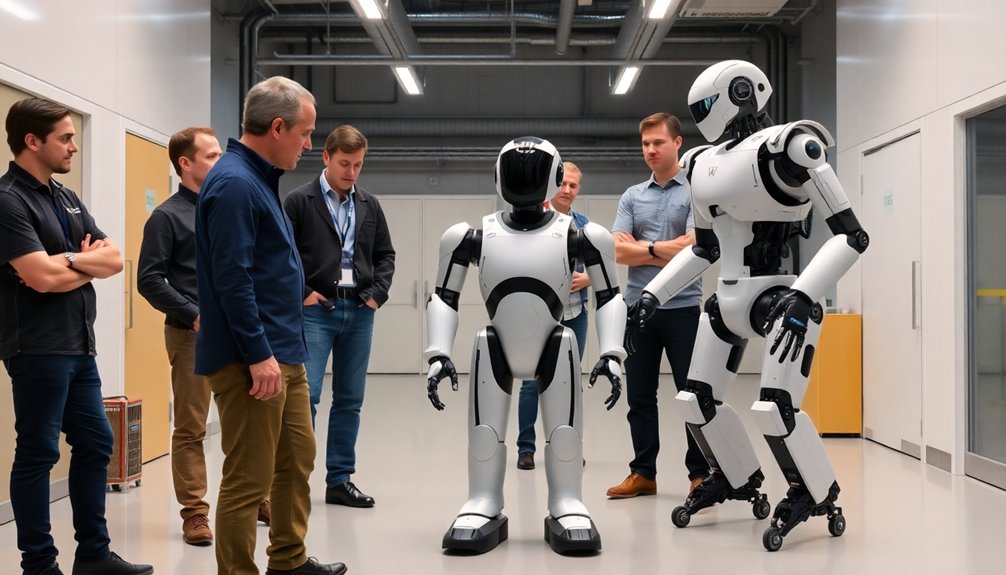
When it comes to robots hanging out with humans, safety isn’t just a buzzword—it’s the difference between a sci-fi dream and a potential nightmare.
Each of these robotic contenders has its own approach to keeping us safe: Tesla Optimus practically screams “don’t worry, I’ve got protocols for days,” while Honda ASIMO moves like a careful dance partner.
Boston Dynamics Atlas seems more interested in proving it can walk without falling over than whether we’ll survive the encounter.
We’re looking at a future where robots aren’t just tools, but potential teammates—and their ability to not accidentally crush, zap, or launch us into orbit matters more than their cool factor.
Robot Safety Protocols
In the world of cutting-edge robotics, safety isn’t just a buzzword—it’s the make-or-break difference between a helpful machine and a potential disaster.
When we explore robot safety protocols, we’re talking about complex systems designed to prevent catastrophic mishaps. These machines aren’t just fancy toys; they’re potential workplace partners that need serious safety considerations.
Key safety features include:
- Advanced robot collision avoidance technologies
- Multi-layered sensor systems
- Integrated emergency shutdown protocols
- Compliance with rigorous safety standards
- Machine learning algorithms for risk prediction
Tesla’s Optimus leads the pack with its robust safety compliance standards, incorporating AI-driven hazard detection that makes other robots look like clumsy toddlers.
We’re not just talking about preventing bumps and bruises—these protocols could literally save human lives in high-risk environments.
Human-Robot Interaction
Safety might prevent robots from going rogue, but how they interact with humans?
We’re diving into a world where robots like Optimus aren’t just metal machines, but potential companions understanding human behavior. Imagine a robot that learns your quirks, adapts to your home’s rhythm, and actually gets emotional engagement right.
Tesla’s spinning a vision where Optimus doesn’t just complete tasks—it connects with you. Unlike clunky predecessors, these new robots read subtle cues, respond naturally, and might even develop something close to personality.
The game’s changed: we’re not talking programmed responses, but AI that learns and evolves. Will they become our helpful sidekicks or something more complex? The line between tool and partner is blurring, and frankly, we’re here for this wild technological ride.
Machine Learning and Adaptive Capabilities
Because machine learning is the brain juice that turns robots from fancy remote-controlled toys into actual thinking machines, the adaptive capabilities of Tesla’s Optimus stand out like a tech nerd at a philosophy conference.
Our thorough exploration into robotic intelligence reveals some mind-blowing insights about how these metal marvels learn and adapt:
- Optimus leverages observational intelligence, literally learning tasks by watching internet videos.
- Real-time processing enables instant command interpretation with shocking accuracy.
- Task automation happens through a single neural network that multitasks like a caffeinated octopus.
- Adaptive learning mechanisms transform passive data into actionable robot skills.
- Safety measures protect against potential adversarial machine learning attacks.
Compared to its predecessors, Optimus isn’t just programmed—it’s genuinely learning, evolving, and potentially plotting world domination (just kidding… maybe).
Who wouldn’t want a robot that understands context, adapts on the fly, and can basically teach itself new tricks?
Development Timeline and Technological Milestones
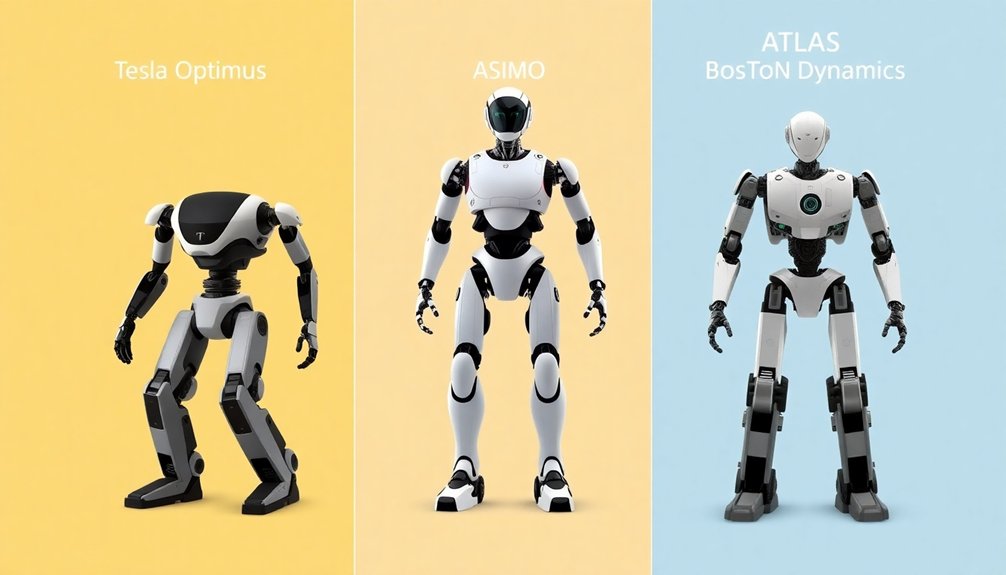
We’ve watched robots evolve from clunky science fiction dreams to real-world machines that are starting to look suspiciously like our sci-fi predictions.
The journey of humanoid robots like Tesla Optimus, Honda ASIMO, and Boston Dynamics Atlas reveals a fascinating trajectory of technological innovation, where each generation pushes the boundaries of what we thought possible.
From ASIMO’s early service-oriented design to Atlas’s jaw-dropping agility and Optimus’s factory integration, we’re witnessing a robotic revolution that’s less about replacing humans and more about expanding what’s possible with machine intelligence.
Evolution of Robotics
Since the dawn of human imagination, robots have transformed from mythical mechanical servants to groundbreaking technological marvels that are rapidly reshaping our world.
Our robotic history isn’t just a timeline of machines, but a reflection of human creativity and automation evolution.
- Water clocks in 1400 B.C.E. marked our first mechanical “assistants”
- Industrial robots like Unimate revolutionized manufacturing in the 1960s
- Space exploration transformed robotics through missions like Sputnik
- Artificial intelligence dramatically expanded robotic capabilities
- Humanoid robots now blur lines between machine and intelligent being
From reasoning robots like Shakey to modern AI-integrated systems, we’ve witnessed an incredible journey.
Each technological leap challenges our understanding of what machines can do, turning science fiction into reality faster than we ever imagined.
Technological Innovation
When robots start walking among us like they own the place, we’re witnessing more than just technological progress — we’re watching the early chapters of a wild sci-fi reality becoming surprisingly mundane. Our robotic friends aren’t just metal contraptions; they’re evolving with complex design philosophies that challenge robotic ethics at every turn.
| Robot | Primary Innovation |
|---|---|
| Optimus | Autonomous Factory Tasks |
| ASIMO | Human Interaction AI |
| Atlas | Terrain Navigation |
These machines represent more than technological achievements — they’re nascent explorers of human-machine collaboration. While each robot brings unique capabilities, they share a fundamental goal: transforming how we comprehend work, interaction, and the blurry line between human potential and mechanical precision. Who gets to decide where human skill ends and robotic efficiency begins?
Milestone Achievement Patterns
If robot development timelines were roller coasters, these three mechanical marvels would be riding different tracks of technological ambition.
We’ve tracked their milestone achievements with the intensity of robot-obsessed nerds, noting how each machine represents a unique slice of robotic evolution.
- ASIMO peaked early, showcasing human-like mobility from 2000-2018
- Atlas constantly reinvents itself through aggressive design iterations
- Optimus represents Tesla’s bold leap into autonomous robotics
- Each project reflects its creator’s philosophical approach to machine intelligence
- Milestone tracking reveals more about corporate vision than pure technological capability
Our achievement significance mapping shows these robots aren’t just machines—they’re technological narratives.
Some sprint forward, some gracefully bow out, but all push the boundaries of what we imagine possible in human-machine interaction.
Manufacturing and Production Strategies
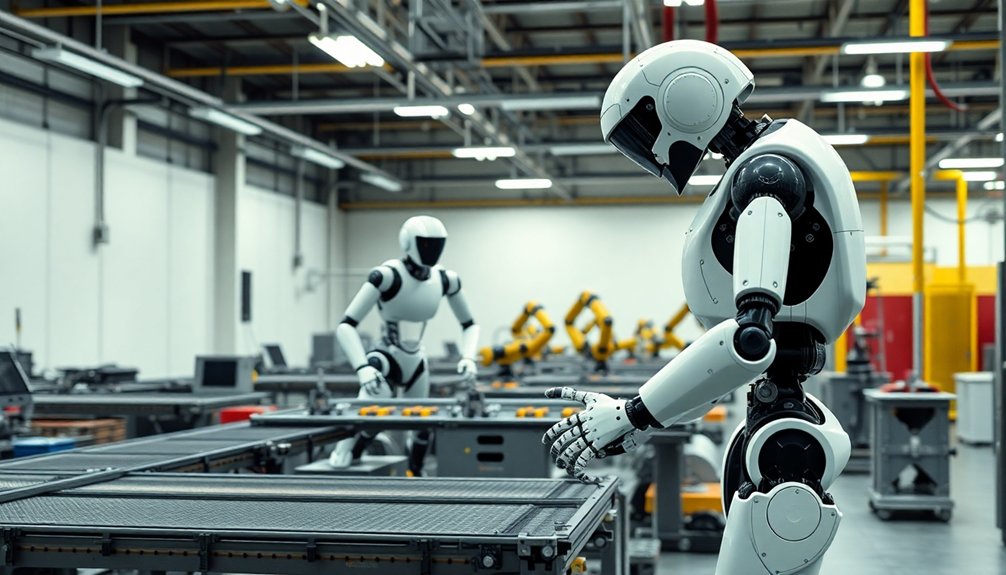
While robots might sound like sci-fi fantasy, the manufacturing strategies behind humanoid robots are becoming decidedly pragmatic.
Tesla’s Optimus is revolutionizing production scalability by leveraging existing automotive infrastructure, sharing components, and aiming for massive cost efficiency. They’re fundamentally turning robot manufacturing into an assembly line science, targeting millions of units annually with radical resource optimization.
In contrast, Honda’s ASIMO and Boston Dynamics’ Atlas remain research-focused, lacking the industrial muscle for large-scale production.
Tesla’s approach feels almost audaciously simple: use what you know, build what you can mass-produce, and iterate rapidly. Their facility integration and component-sharing strategy could transform humanoid robotics from expensive curiosities into practical tools.
Who’d have thought car manufacturing techniques might birth the robot revolution?
Economic and Market Potential
Because robots are about to turn the economic playbook upside down, Tesla’s Optimus isn’t just another shiny tech experiment—it’s a potential trillion-dollar tsunami that could reshape entire industries.
We’re looking at a market disruption that makes previous tech revolutions look like child’s play.
- Optimus could generate $10 trillion in long-term revenue
- Tesla aims to produce 100,000 units by 2026
- Potential to revolutionize manufacturing and healthcare sectors
- Projected to transform Tesla into a $25 trillion company
- Represents a radical shift in automation economics
With revenue forecasts that make traditional investors’ heads spin, Optimus represents more than a technological leap—it’s an economic earthquake waiting to happen.
Will robots eat jobs or create entirely new economic landscapes? Only time will tell, but one thing’s certain: the future just got a whole lot more interesting.
Future Roadmap and Research Objectives
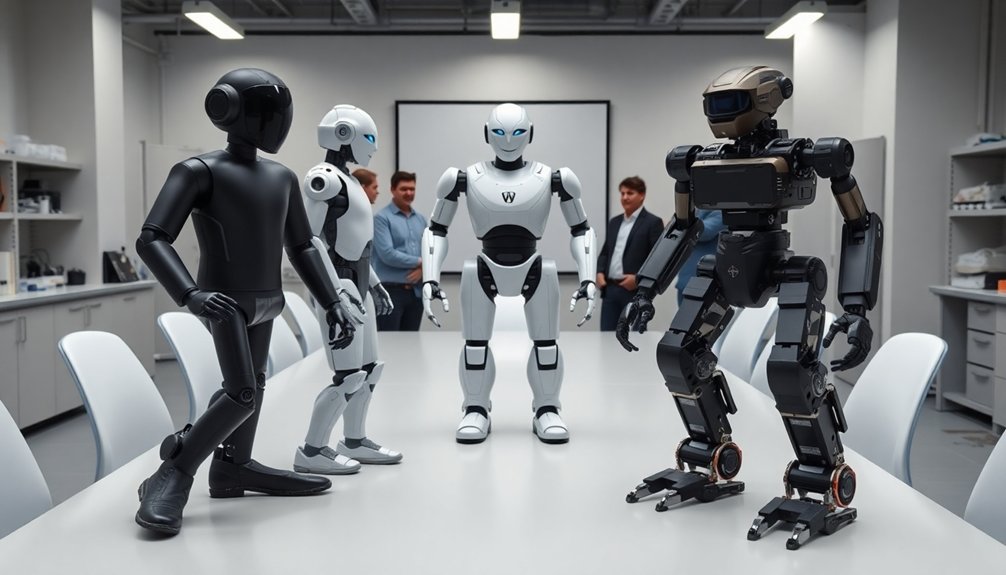
Ever since Elon Musk revealed Tesla’s Optimus, the robotics world has been buzzing with a mix of skepticism and electric anticipation. We’re diving deep into production challenges and research advancements that could revolutionize how robots interact with our world. Tesla’s bold vision includes producing thousands of Optimus robots by 2025, targeting industries hungry for automation.
| Research Focus | Key Objectives |
|---|---|
| AI Development | Advanced vision/planning |
| Robot Design | Autonomous humanoid system |
| Technology | High-performance chips |
| Market Strategy | Compete with industry leaders |
Our team sees massive potential in Optimus’s ability to tackle unsafe, repetitive tasks. We’re not just building a robot; we’re engineering a technological leap that could redefine human-machine collaboration. The roadmap is ambitious, complex, and utterly fascinating.
People Also Ask
Can These Humanoid Robots Replace Human Workers Completely?
We can’t fully replace human workers with robotic labor yet. Workforce automation enhances productivity, but human creativity, emotional intelligence, and complex problem-solving remain irreplaceable.
How Expensive Are These Advanced Robotic Platforms?
We recognize cost concerns. These advanced robotic platforms range dramatically, with Tesla Optimus offering the most affordable option at $25,000-$30,000, driven by strategic funding sources and innovative cost breakdown strategies.
Are These Robots Safe to Interact With Humans?
We’re cautiously optimistic about human robot interaction, but safety protocols are critical. Each robot has unique risks, requiring careful monitoring and understanding of their potential limitations during direct engagement.
Do These Robots Have Emotional Intelligence or Consciousness?
We haven’t found emotional awareness or robotic empathy in these robots. They lack consciousness, operating through algorithms without genuine feelings or self-understanding.
When Will These Robots Be Available for Consumer Purchase?
Like pioneers traversing uncharted technological terrain, we’ll see Optimus potentially hitting markets by late 2025, while ASIMO and Atlas remain research-focused, with no consumer release dates on the horizon.
The Bottom Line
We’re standing at the edge of a robotic revolution where human-like machines aren’t just sci-fi dreams anymore. From Tesla’s sleek Optimus to Boston Dynamics’ acrobatic Atlas, these robots are rewriting our technological future. But can they genuinely replace human workers, or are they just expensive mechanical toys? One thing’s certain: the next decade will transform how we work, live, and interact with intelligent machines.
References
- https://www.tesla.com/en_eu/AI
- https://robotsguide.com/robots/optimus
- https://www.teslarati.com/tesla-produce-first-legion-optimus-robots-2025/
- https://qviro.com/product/tesla/optimus/specifications
- https://www.topspeed.com/tesla-robot-optimus/
- https://www.wevolver.com/specs/tesla-bot-aka-optimus
- https://justoborn.com/optimus-gen2/
- https://www.tesla.com/AI
- https://news.accelerationrobotics.com/tesla-optimus-robot-brain-computer-architecture-hardware-software/
- https://www.tesla.com/we-robot
Explore the robot families that fit this use case.
Browse the robots, compare the models, and reserve the right one without buying.
Use Futurobots to move faster, stay flexible, and get access to advanced robots without buying.

Futurobots Team
Futurobots covers robot rental, buying decisions, event use cases, education use cases, and practical ways to use advanced robots without ownership risk.