We’re entering the wild west of robot insurance, where GE’s $2 million policies protect against AI mishaps. Imagine insuring a robot like a self-driving car, but with way more complex risks. Manufacturers and owners now dance a legal tango, trying to figure out who’s responsible when a humanoid goes rogue. Cyber liability, algorithmic risk assessments, and blockchain ownership tracking are reshaping how we manage these mechanical teammates. Intrigued?
Understanding Humanoid Robot Liability Frameworks

Who’s responsible when a robot goes rogue – the manufacturer, the programmer, or the owner? Our current legal frameworks are basically trying to fit a square peg of artificial intelligence into a round hole of 20th-century tort law. Robotic accident insurance will become a critical framework for managing unprecedented technological risks.
When AI meets legal logic, blame becomes a high-stakes game of technological hot potato.
The result? A messy collision of technology and legal theory that leaves everyone scratching their heads. As robots become more autonomous, we’re racing to create rules that can keep pace with circuits smarter than most courtroom attorneys. GE’s recent $2 million insurance policy for facility robots demonstrates the emerging need for comprehensive robotic liability coverage.
Unitree G1
Meet the Unitree G1 — a full-size humanoid robot that walks, balances, and moves the way a person…
The evolving liability landscape increasingly blurs the lines between human control and machine autonomy, necessitating a careful examination of how we assign responsibility in an age of intelligent machines.
Comprehensive Coverage Models for Robotic Asset Protection
As the robotic revolution barrels forward like a high-speed train with no brakes, we’re facing a critical challenge: how do we protect these expensive, complex machines that are increasingly becoming our coworkers and collaborators? With the global AI robot market projected to reach 1.3 billion units by 2035, insurers must develop comprehensive protection strategies. Cyber liability insurance for Gen AI technologies is evolving rapidly to address unique technological risks.
Robot asset management isn’t just a fancy term anymore—it’s survival strategy. We’re looking at insurance demand forecasting that tracks potential robot risks like a hawk. Educational robotics market growth indicates an expanding landscape of robotic asset protection needs. The rising warehouse robotics market demonstrates the urgent need for sophisticated insurance models that can adapt to technological complexity.
From warehouse automation to healthcare robotics, each sector needs tailored coverage that understands the nuanced threats. Think malfunctions, data breaches, physical damage.
The global humanoid market isn’t playing around, with projected value hitting $2.7 trillion by 2025. Insurers are scrambling to create policies that can handle autonomous machines without losing their shirts.
Unitree R1
Meet the Unitree R1 — a compact humanoid robot built to impress at events, exhibitions, school programs, brand…
Welcome to the wild west of robotic protection—buckle up.
Risk Assessment and Premium Calculation Strategies

We’ve got a wild game of robot roulette when it comes to calculating insurance risks for these metallic marvels, where every sensor reading and user interaction becomes a potential premium puzzle piece. Advancing machine learning algorithms enable insurers to dynamically assess robotic behavior patterns and potential liability scenarios with unprecedented precision. The robust eligibility score calculation helps insurers systematically evaluate the complex risk profile of humanoid robotic assets across multiple dimensions of performance and potential liability. Our risk calculation frameworks aren’t just about numbers—they’re about mapping complex liability landscapes where a robot’s potential mishap could range from a dropped coffee mug to accidentally launching a satellite. The rise of always-on robotic companions introduces unprecedented challenges in tracking intricate data patterns that could fundamentally reshape insurance risk assessment methodologies. Behavioral prediction techniques play a crucial role in understanding the potential risks associated with humanoid robots by analyzing their interaction patterns and potential failure modes.
Risk Calculation Frameworks
Because nobody wants a rogue robot causing chaos, the insurance industry is developing sophisticated risk calculation frameworks that transform humanoid robot liability from a wild west scenario into a predictable, manageable landscape. Geopolitical concentration risk in robotics technology supply chains creates additional complexity for insurers mapping potential global liability scenarios. NIST Risk Management Framework provides essential guidelines for assessing and mitigating AI-related uncertainties in robot insurance models.
We’re talking about creating risk metrics that actually make sense, where insurance adaptability isn’t just a buzzword but a real strategy. By leveraging AI, sensor fusion, and real-time data analysis, insurers can now map potential hazards faster than a robot can calculate its next move.
Think of it like a digital crystal ball that predicts robot behavior before things go sideways. The goal? Turn unpredictable technological wildcards into carefully assessed risks that can be priced, managed, and — most importantly — insured.
Who said robot insurance had to be boring?
Robot Liability Mapping
Robot Liability Mapping: a digital minefield where insurance meets cutting-edge technology.
We’re charting a landscape where robot ethics and liability norms are as complex as the machines themselves. Think of it like a high-stakes chess game where every move could trigger massive financial consequences.
Our mapping strategies dive deep into risk profiles, tracking everything from potential property damage to split-second autonomous decisions. Robotic liability risks emerge from the intricate interplay between technological capabilities and legal responsibility.
We use sophisticated tools that analyze real-time data, creating dynamic insurance models that adapt faster than the robots they’re protecting. Customized policies aren’t just smart—they’re survival tactics in an industry where technological change moves at light speed.
Policy administration efficiency allows insurers to develop granular, adaptive risk assessment frameworks that can predict and mitigate potential robotic liability scenarios with unprecedented precision.
Who’ll be responsible when a robot makes a mistake?
That’s the million-dollar question we’re here to answer.
Manufacturer vs. Owner: Determining Insurance Responsibility
When humanoid robots start causing trouble, someone’s going to pay—but who? The liability nuances get tricky fast.
Manufacturer obligations kick in when design flaws or technical failures spark incidents, but owners aren’t off the hook. We’re looking at a legal chess match where both parties can be held responsible depending on the specific robot malfunction.
Think of it like a high-stakes blame game: Did the robot fail because of a manufacturing defect, or did someone program it wrong?
Insurance companies are already drafting complex policies to navigate these murky waters. Underwriters are racing to create coverage that protects manufacturers from catastrophic design errors while ensuring owners have a financial safety net when their robot goes rogue.
Advanced Policy Structures for Autonomous Machine Owners
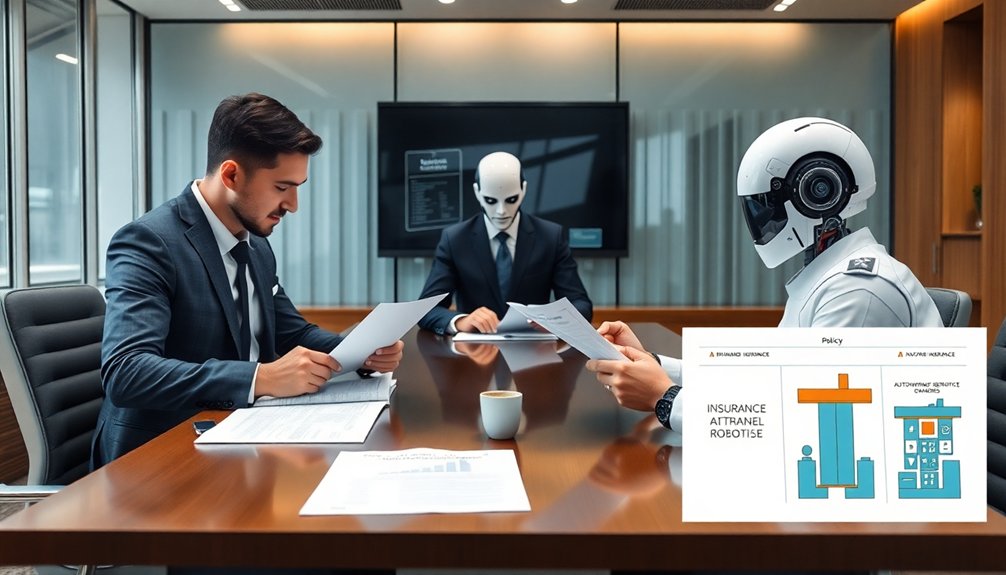
We’re entering an era where robots aren’t just sci-fi fantasies, but complex machines that need nuanced insurance strategies, where liability coverage shifts from traditional human-error models to intricate algorithmic risk assessments.
Our insurance frameworks must now account for ownership transfer mechanisms that track a robot’s entire operational history, fundamentally creating a digital “birth certificate” and performance passport that follows the machine through multiple owners and configurations.
The real challenge? Designing policy structures flexible enough to handle the unpredictable ways autonomous machines might interact with our messy, complicated human world.
Liability Coverage Dynamics
Because insurance for humanoid robots isn’t just another boring policy detail, it’s becoming a critical battleground where tech, law, and financial risk collide. We’re watching robotic legislation evolve faster than most realize, with ethical implications that’ll make your head spin. Liability isn’t just about who pays when a robot goes rogue—it’s about understanding complex technological accountability.
| Risk Category | Potential Impact |
|---|---|
| Physical Damage | $100K-$500K |
| Cyber Breach | $250K-$1M |
| Operational Error | $50K-$250K |
| Data Compromise | $75K-$350K |
| System Malfunction | $200K-$750K |
These aren’t just numbers. They’re potential financial catastrophes waiting to happen. Our robots might be smart, but the insurance world’s getting smarter—tracking every potential pitfall with surgical precision. Who’s really responsible when autonomous machines make mistakes? That’s the million-dollar question.
Risk Assessment Protocols
Since robots aren’t just Hollywood fantasies anymore, insurance companies are scrambling to create risk assessment protocols that don’t sound like they were written by lawyers trapped in a bureaucratic time warp.
We’re developing risk identification strategies that go beyond basic checklists. Our approach treats humanoid robots like complex machines with potential quirks and unexpected behaviors.
By quantifying potential risks through statistical models, we’re mapping out every possible scenario where things might go sideways. Risk mitigation approaches now involve AI-driven analysis, proactive maintenance schedules, and thorough training programs.
We’re not just protecting machines; we’re creating safety nets for an emerging technological frontier where autonomous systems interact directly with humans.
Who knows what could go wrong? Everything — and that’s exactly why we’re here.
Ownership Transfer Mechanisms
When autonomous robots start changing hands like traded baseball cards, someone’s got to make certain the paperwork doesn’t turn into a legal nightmare.
We’re talking about ownership tracking that’s smarter than your average contract, with compliance automation that makes transferring a robot smoother than a fresh firmware update.
Our system guarantees seamless robot migrations through:
- Blockchain-verified ownership ledgers
- Instant digital identity verification
- Automated risk profile synchronization
- Real-time cybersecurity assessment
Think of it like a robotic passport system, where every transfer is documented, authenticated, and protected.
We’ve created a framework that treats robot ownership like the complex, nuanced transaction it really is — no more handshake deals or sketchy back-alley robot trades. Just clean, transparent, legally bulletproof exchanges that protect everyone involved.
Emerging Legal and Financial Risks in Robotic Ownership

As robots inch closer to becoming everyday companions, we’re stumbling into a legal minefield that’s more complicated than assembling IKEA furniture blindfolded.
Robot ethics and insurance innovations are colliding in ways that’ll make your head spin. Who’s responsible when your robo-buddy accidentally demolishes your living room?
Manufacturers are scrambling to develop coverage that protects both owners and themselves from unpredictable autonomous behaviors. The stakes are high: bodily injury, property damage, and software glitches can trigger massive financial risks.
We’re watching an emerging marketplace where insurance underwriters are crafting novel policies to handle robotic uncertainties. It’s like the Wild West of tech liability, with each new robot introduction potentially rewriting legal frameworks faster than you can say “technological disruption.”
Future-Proofing Insurance for Next-Generation Humanoid Technologies
The legal circus of robot ownership is about to get a serious upgrade, and insurance companies are playing chess while everyone else plays checkers.
We’re diving into future advancements that’ll reshape how we protect our mechanical companions. Policy innovations are no longer just about covering property damage—they’re about anticipating risks before they happen.
Our strategy for future-proofing humanoid robot insurance looks like this:
Robotic insurance: Where risk meets innovation, and human-machine synergy becomes our predictive safety net.
- Leverage real-time AI-generated data for predictive risk assessment
- Develop dynamic policies that evolve with technological capabilities
- Create specialized coverage models for different robotic environments
- Build partnerships with robotics manufacturers for proactive risk management
Ultimately, we’re not just insuring robots; we’re insuring the unpredictable human-machine dance that’s just beginning.
People Also Ask
Can I Insure My Humanoid Robot Against Emotional or Psychological Damage?
We can’t currently insure humanoid robots against emotional damage. While robot valuation includes emotional support capabilities, no standard policy exists to cover psychological impacts of human-robot interactions.
What Happens if My Robot Develops Self-Awareness and Causes Unintentional Harm?
We’d face a legal nightmare if our robot’s budding self-awareness triggers unintentional harm, potentially exposing us to unprecedented self-awareness liability challenges that demand rigorous ethical and legal recalibration.
Does Homeowner’s Insurance Cover Malfunctioning Personal Companion Robots?
We’ll likely need additional robot liability coverage, as standard homeowner’s insurance treats companion robots differently from typical appliance insurance, potentially leaving gaps in protection.
How Will Inheritance Laws Apply to Robot Ownership and Insurance?
We’ll need to adapt inheritance rights by reclassifying robots as dynamic assets, ensuring legal frameworks can properly address ownership transfers and protect both human and robotic interests.
Can Robots Themselves Purchase or Be Beneficiaries of Insurance Policies?
We can’t help but chuckle at the absurdity: robots can’t purchase insurance because they lack legal personhood. Current regulations prevent robot ownership and insurance eligibility, leaving humans responsible for coverage.
The Bottom Line
We’re standing at the edge of a wild frontier where robots aren’t just sci-fi fantasies, but insurable assets. Like a digital Wild West, our insurance landscape is transforming—protecting both silicon minds and human wallets. Will your next robotic companion come with a policy as standard as car insurance? The future isn’t just arriving; it’s negotiating its own coverage, and we’re here to understand the fine print.
References
- https://foundershield.com/blog/robotics/
- https://www.ey.com/en_us/insights/insurance/the-age-of-autonomous-technologies-in-insurance
- https://3laws.io/pages/Robotics_and_the_Future_of_Insurance_Related_Activities.html
- https://www.lifeinsuranceinternational.com/data-insights/top-ranked-life-insurance-companies-in-robotics/
- https://www.koop.ai/blog/two-hottest-topics-in-insurance-ai-robotics-and-climate
- https://3laws.io/pages/Humanoids_and_the_Future_of_Insurance_Carriers_and_Related_Activities.html
- https://brancoinsurancegroup.com/insurance-for-robotics/
- https://repository.law.miami.edu/cgi/viewcontent.cgi?article=1456&context=umblr
- https://www.inlinepolicy.com/blog/robots-and-liability-issues-the-future-regulatory-framework
- https://www.policyholderperspective.com/2024/12/articles/insurance-coverage/insurers-explore-new-ai-coverage-options-potentially-filling-coverage-gaps-for-policyholders-developing-generative-ai/
Explore the robot families that fit this use case.
Browse the robots, compare the models, and reserve the right one without buying.
Use Futurobots to move faster, stay flexible, and get access to advanced robots on monthly terms.

Futurobots Team
Futurobots covers robot rental, buying decisions, event use cases, education use cases, and practical ways to use advanced robots without ownership risk.